
Can Kevlar phone cases really take care of both feel and protection? The three types of people close their eyes and enter, and the two types of people must not touch them
Nearly 40% of the mobile phone cases marked “Kevlar” on the market are actually just plastic cases printed with a texture – this counter-common fact reveals the most common information gap in the high-end mobile phone case market.
When “bare metal feel” and “indestructible” became the core demands of users, aramid fiber (i.e. Kevlar) was quickly praised as the ideal answer. But the problem of being difficult to distinguish between true and false and uneven experience also followed. In the past five years, I have measured hundreds of mobile phone cases, from liquid silicone to carbon fiber, and have stepped on many pitfalls that “feel good but crack when you fall”. The Kevlar case, which really uses military-grade aramid fiber, has indeed found a rare balance between thinness and drop resistance.
But it’s not a panacea and it’s by no means for everyone. This article will combine measured data, user feedback and material principles to help you clarify: Is Kevlar shell worth buying? In what scenarios is it more suitable than a normal TPU or PC case? Who should not choose it at all?
01|Kevlar’s real ability boundary: where is the strength? Where is the weakness?
Kevlar is a para-aramid fiber developed by DuPont, which is five times stronger than steel of the same quality and weighs only one-fifth of it, and is widely used in high-demand fields such as body armor and spacecraft. When used on mobile phone cases, its advantage is not to rely on thickness to carry the impact, but to quickly disperse the local impact force to the entire back panel through a high-density weave structure to avoid stress concentration causing the screen or frame to crack.
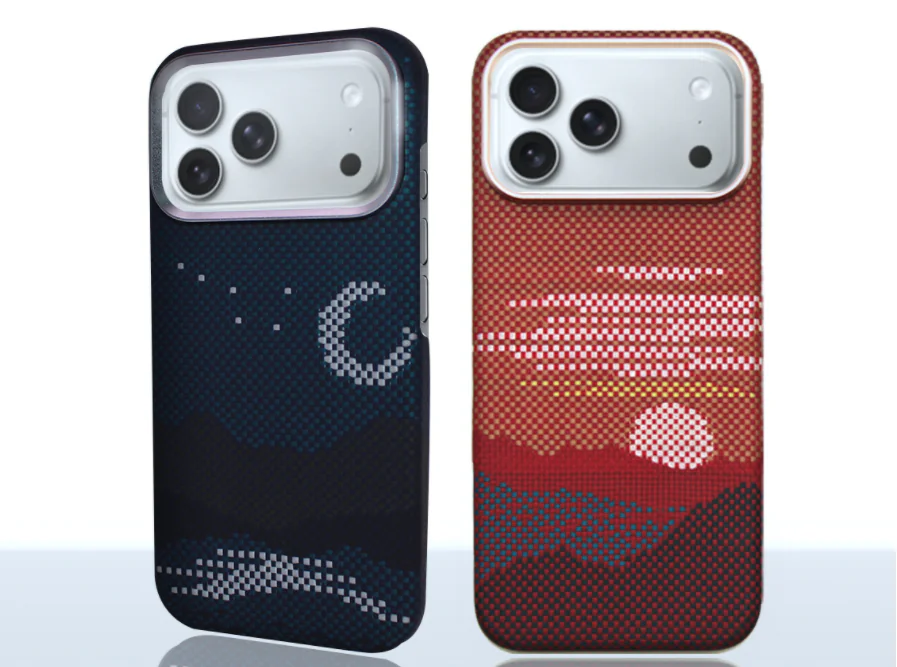
toFor example, when the corners of the phone hit the concrete floor, the hard coating on the surface of the shell will shatter and peel off, revealing the weaving lines below – this seems to be “damaged”, but in fact it absorbs energy through its own sacrifice to protect the internal metal middle frame and lens module. This “active cushioning” mechanism allows the Kevlar case to effectively cope with daily bumps when it is only 0.97mm thick and weighs 18.5g.
In contrast:
- TPU soft shell relies on elastic deformation and energy absorption, and is prone to aging and yellowing after multiple drops;
- PC hard shells rely on rigidity to resist impact, but lack toughness, and will break directly once the critical point is exceeded.
| Dimensions | Kevlar shell | TPU softshell | PC hard shell |
|---|---|---|---|
| Thickness (typical) | 0.6–1.2mm | 1.0–1.8mm | 0.8–1.5mm |
| 重量(iPhone 17 Pro Max) | 12–25g | 25–40g | 20–35g |
| Impact resistance principle | Energy diffusion + surface sacrifice | Elastic deformation absorbs energy | Rigid resistance |
| Yellowing resistance | Excellent (almost non-yellow) | Poor (significant yellowing at 3–6 months) | Medium (long-term UV exposure with yellow) |
| Key Accuracy | High (usually equipped with independent metal/ceramic buttons) | Low (integrated soft adhesive, fuzzy feedback) | Medium (hard plastic buttons, easy to loosen) |
| Thermal performance | Excellent (fiber thermal conductivity + skeleton design) | Poor (rubber insulation) | Medium (Plastic thermal conductivity is general) |
| Signal interference | None (non-metallic) | None | Some models are available (including metal trim) |
However, Kevlar also has shortcomings:
- Corner protection depends on coating integrity: once broken, the secondary protection ability of this position is greatly reduced;
- The all-inclusive design is difficult to disassemble: it is necessary to push the edge evenly to avoid cracking the shell caused by forced dismantling of a single corner;
- Low-priced products are mostly “pseudo-Kevlar”: shells below 150 yuan are likely to be printed with PP or PET substrate, which not only has no impact resistance, but may also be sticky due to inferior coatings;
- Performance deterioration in low temperature environment: below -10°C, aramid fiber brittleness increases, and drop resistance may be reduced, outdoor workers need to be cautious.
02|Who is suitable for buying Kevlar shells? Decision-making guidelines for three types of people
✅ Ideal for Group 1: Commuters & Those Who Frequently Carry Their Phone in an Outer Jacket Pocket
These users are most concerned about scratched frames or screen cracks from face-down drops. Kevlar cases are exceptionally lightweight and slim—some, like the Hipporizz model, weigh just 12g—adding virtually no bulk. Combined with a 0.5mm raised camera bezel and reinforced corner coverage, they effectively handle everyday bumps. Plus, most support MagSafe, making car mounts and wireless charging more convenient.
✅ Ideal for Group 2: Users Who Crave “Bare-Phone Feel” But Fear Scratches
If you can’t stand the anxiety of scuffing your aluminum frame yet don’t want to compromise on grip or tactile experience, a Kevlar case is arguably the closest thing to an ideal solution available today—lightweight, ultra-thin, highly durable, and resistant to yellowing.
✅ Ideal for Group 3: Discerning Users Who Value Craftsmanship and Premium Details
Most high-end Kevlar cases feature independent metal or ceramic buttons, precisely cut openings, and metal-reinforced camera rings. Their overall build quality far surpasses that of ordinary plastic cases, making them perfect for users who prioritize premium materials and attention to detail.
❌ Not Recommended for Group 1: Hardcore Mobile Gamers
Although Kevlar shells have a matte, slightly textured surface, prolonged gripping—especially when your hands get sweaty—significantly reduces friction, making the phone prone to slipping. In contrast, liquid silicone cases or TPU cases with anti-slip patterns offer better grip during intense gameplay. If you still prefer a Kevlar case, opt for models with enhanced side textures (e.g., newcloth’s Chi Bi series).
❌ Not Recommended for Group 2: Users with a Budget Under ¥150
Authentic Kevlar requires high-temperature, high-pressure autoclave curing during manufacturing, resulting in higher production costs. Reputable brands like PITAKA and Benks typically price their Kevlar cases above ¥300. Products under ¥100 that claim to use “aramid fiber” are very likely just plastic shells printed with a fake weave pattern, offering questionable protection. If you’re on a tight budget, consider entry-level options from brands like Pinkson (around ¥155), but be sure to verify whether they feature an independent metal camera ring and precisely aligned cutouts.
Addendum: Kevlar cases are diversifying—choosing the right type matters more than ever.
The market has now settled into three dominant styles:
- Ultra-thin half-wrap cases (e.g., Bangk Fiber Case at just 9.4g): Deliver an almost bare-phone feel but offer minimal frame protection.
- Heavy-duty full-wrap cases (e.g., JUESAI Qiji series at 30g): Combine TPU soft edges with an aramid fiber back for comprehensive drop protection—at the cost of added weight.
- Slim full-wrap cases (e.g., newcloth Chitu at 24g): Strike a new balance between tactile comfort and impact resistance, emerging as the mainstream choice.
Conclusion: It’s not a one-size-fits-all case—but for specific needs, it’s almost the only solution.
Kevlar phone cases are designed to protect against everyday bumps and drops, not high-altitude falls. They’re ideal for refined, careful use—not extreme conditions. If you crave that “bare-phone” feel yet can’t tolerate scratched edges, a genuine Kevlar case is currently the closest thing to an ideal choice.
When purchasing, pay close attention to three key factors:
- Full corner coverage – essential for reliable corner protection;
- Metal lens ring – prevents scratches on your camera lenses;
- Magnetic strength – must meet or exceed 1.2 kg to ensure stable MagSafe attachment.
Only when these criteria are met can you truly “have both bare-hand feel and peace of mind—in one go.”